Internet Anthropologist Think Tank

  • Search our BLOG


  • HOME
    Terrorist Names SEARCH:
    Loading

    Tuesday, June 10, 2008

    al Qaeda OK in Paki


    North Waziristan peace agreement allows Al Qaeda to remain
    taliban-presentation-thumb.JPG

    Multimedia presentation of the senior Taliban commanders in Pakistan and Afghanistan. Click to view.

    With the flurry of negotiations under way in Northwest Frontier Province and the tribal areas, details are finally leaking about the North Waziristan peace agreement that was signed in February.

    The Daily Times, a Pakistani news organization, has obtained a copy of the peace agreement. The agreement lets al Qaeda leaders and operatives remain in North Waziristan "as long as they pledge to remain peaceful."

    While the agreement was signed in mid-February, the details of the North Waziristan accord have remained a secret. The Pakistani government has purposefully kept the deal secret, and built in language to prevent the Taliban from disclosing details. Based on information released by the Northwest Frontier Province’s Governor’s office and the Daily Times, the terms of the agreement are as follows:

    • "Foreigners' must leave North Waziristan.
    • Al Qaeda operatives can live in North Waziristan "as long as they pledge to remain peaceful."
    • The Taliban may not establish a parallel government.
    • The Taliban must halt attacks on government and security forces personnel.
    • The Taliban "agreed to jointly struggle against extremism and terrorism throughout the agency."
    • Disclosing the contents of the peace agreement is prohibited.
    • A fine of about $740,000 will be assessed for anyone violating the terms of the agreement.
    • The government will withdraw the Army and turn over security to the paramilitary Frontier Corps.
    • The government will release captured Taliban leaders and fighters.

    The agreement does not mention existing al Qaeda and Taliban terror training camps or the ending of cross-border attacks into Pakistan. The Taliban established a shadow Taliban government after the 2006 peace agreement, and by all accounts it remains in place. The Taliban runs recruiting offices, courts, and jails, taxes the population, and maintains security forces. The Taliban and al Qaeda are known to run 29 training camps in North and South Waziristan.

    The powerful Haqqani family is based in North Waziristan. The Haqqani family runs several mosques and madrassa, or religious schools, near Miramshah. The Pakistani government closed down the radical Haqqani-run Manbaul Ulom madrassa after the US commenced Operation Enduring Freedom in Afghanistan, but the school was reopened in 2004. The Manbaul Ulom madrassa has been described as a center of jihadi activities, where top Taliban and al Qaeda commanders meet.

    Siraj Haqqani, the son of renowned Taliban leader Jalaluddin Haqqani, is on of the senior Taliban leaders in North Waziristan. He has close ties to Osama bin Laden and the Taliban. He has embraced al Qaeda's tactics and ideology, and has recruited foreign terrorists to act as suicide bombers and operatives inside Afghanistan. Siraj is believed to be running the Haqqani Network in eastern Afghanistan and has become a focal point of Coalition operations. The US military has put out a $200,000 bounty for Siraj's arrest. Taliban commanders Hafiz Gul Bahadar and Sadiq Noor also operate in North Waziristan.

    SOURCE:

    For more information on the terms of the peace agreements in Swat, Bajaur, North Waziristan, and Mohmand, and the proposed terms for the agreements in South Waziristan, Mardan, and Kohat, see:

    Descent into Appeasement
    Pakistani government inks peace deal with Swat Taliban
    Pakistan is negotiating a new peace agreement with Baitullah Mehsud (South Waziristan)
    Pakistan revives the North Waziristan Accord
    Pakistan releases Taliban leader, signs peace deal with outlawed Taliban group (Bajaur, Malakand Division)
    Pakistan strikes deal with the Taliban in Mohmand
    Negotiations with the Taliban under way in Kohat
    Negotiations under way with Taliban in Mardan

    See The Fall of Northwestern Pakistan: An Online History for more information on the rise of al Qaeda and the Taliban in Pakistan and the history of peace agreements signed between the government and the Taliban.

    xxxxxxxxxxxxxxxxxxxxxxxxxxx

    Geeze, I just don't know what to say or where to begin?

    They kept the terms a Secret, and made the Taliban keep quite about it.

    The Taliban control the Government in parts of Paki.

    al Qaeda has a safe haven, with the Pakistani Governmental approval.

    The Taliban admit they will continue attacks in Afghan, and Baitullah's men were

    killed in Afghan a few days ago.

    Will the Paki Government protect the Taliban while they attack cross border into

    Afghan.

    And protect al Qaeda while they plot terrorism around the world?

    It would seem the Paki government is so afraid of the Taliban ( they don't even call them terrorist ) the Paki Government is willing to cede control of part of their country.

    Or the Paki Government is so corrupt as to get into bed with the Terrorist, the Taliban and al Qaeda.

    This has already been tried, they gave Hitler some countrys to try and appease him and it just encouraged him, and triggered WWII.

    Pakis intention was or is to give shelter to terrorist in exchange for a pledge not to kill in Pakistan.

    Where is the honor of the Paki Government?

    THE TALIBAN HAVE NO HONOR,

    BUT I THOUGHT THE PAKI PEOPLE,

    GOVERNMENT DID?

    They will allow thugs, miscreants, criminals, terrorist to live amongst them if they promise not to kill in Pakistan. Such courage, such moral fibre, such HONOR.

    Gerald

    Qureshi talking out of both sides of his mouth

    Zemanta Pixie

    Labels: , , , , , , , ,

    Terrorist Names SEARCH:
    Loading

    Saturday, June 07, 2008

    Pak govt to release 64 Taliban

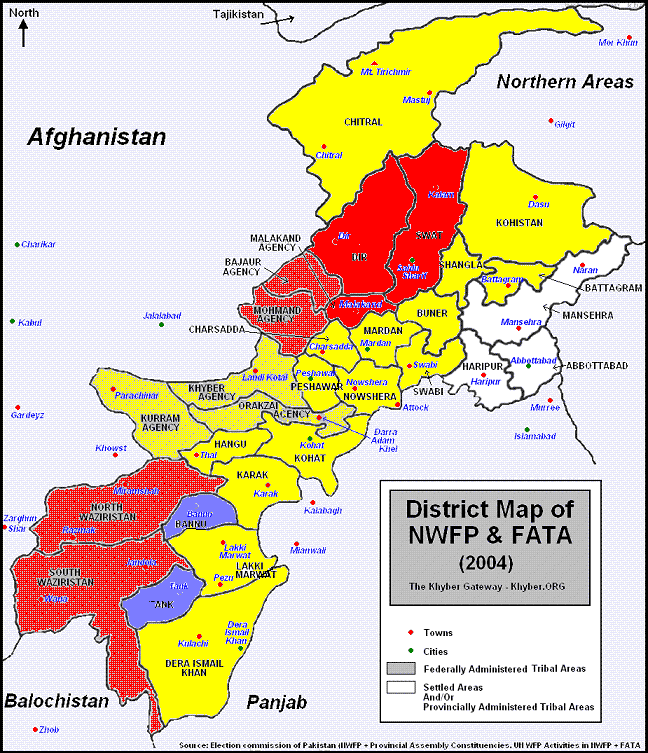
    Map showing the districts of the Federally Administered Tribal Areas (FATA) FATA and the North-West Frontier Province (NWFP) of Pakistan.Image via WikipediaPak govt to release 64 Taliban militants

    By Our Pakistan Correspondent

    Islamabad

    June 6: The Pakistan government has agreed to release 64 militants loyal to Taliban leader Maulana Fazlullah, popularly referred to as Mulla Radio, as part of a peace deal with the local Taliban.

    The North-West Frontier Province (NWFP) government has agreed to free detained Taliban militants loyal to Maulana Fazlullah in three phases, with at least 64 militants to be released in the first phase, a government official said.

    The new deal is the follow-up of an accord struck between the Swat Taliban and the government last month.

    In the 15-point deal reached last month, the militants agreed to halt suicide attacks and bombing on security forces and government installations. In exchange, the government promised the release of local Taliban militants arrested during military operations and imposition of Nizam-e-Adl.

    (justice system) in Malkand division.

    Pakistani troops also agreed to withdraw from the restive South Waziristan areas when local Taliban chief Baitullah Mehsud will free captured Army and paramilitary personnel.

    http://www.asianage.com/presentation/leftnavigation/news/international/pak-govt-to-release-64-taliban-militants.aspx

    http://snipurl.com/2ee1z
    Zemanta Pixie

    Labels: , , , , , , , , , ,

    Terrorist Names SEARCH:
    Loading

    Monday, June 02, 2008

    Ops and Intel update


    For the history buffs
    Biny's last cell phone number was

    00873 682 505 331

    xxxxxxxxxxxxxxxxxxxxxxxxx

    The last probable sighting was in late 2001, when special forces and Afghan allies pursued a "tall man on a horse" into the mountains of Tora Bora,

    xxxxxxxxxxxxxxxxxxxxxxx

    Pentagon withdrew the Fifth Special Forces Group – the only commando team with soldiers conversant in Pashto, Dari and Arabic – to replace them with the Seventh Group, whose main operational tongue is Spanish.

    Bits and pieces,G

    xxxxxxxxxxxxxxxxxxxxxxxxxxxxx

    Taliban have no HONOR

    KABUL, Afghanistan — Shauker Ullah says he agreed to blow himself up in March.

    He did not know how to drive a car or read a book. His only schooling was four months in a Pakistani Islamic madrassa, where he learned to recite the Quran but not the meaning of its verses. After a few promises, he agreed to go across the border to Afghanistan and kill foreign soldiers.

    Ullah was 14.

    ......................


    Taliban have no HONOR

    "They're using kids, they're using drug addicts, they're using people who are mentally ill, mentally challenged," said Humayun Hamidzada, the spokesman for Afghan President Hamid Karzai.

    ..........................

    Last summer, Karzai pardoned a 14-year-old Pakistani boy who planned a suicide attack in Afghanistan after being recruited in a Pakistani madrassa.

    Last June, militants in the southeastern Afghan city of Ghazni forced a 6-year-old boy to wear an explosives vest and told him to walk up to U.S. soldiers.


    Taliban have no HONOR

    After asking Afghan soldiers for help, the boy said he was told that when he pressed the button, flowers would shoot out, officials said at the time.

    Militants on both sides of the border appear to be using young people.

    ...............................

    One of the first suspects arrested in December's slaying of former Pakistani Prime Minister Benazir Bhutto was 15, from near the tribal areas of Pakistan.


    Taliban have no HONOR

    A video circulated on the Internet last year showing a boy from remote southwestern Pakistan, near Afghanistan's border, cutting off the head of a man accused of being a U.S. spy. The boy was purportedly 12, and the incident drew condemnation from Pakistani officials and international organizations like UNICEF.

    In February, the Pakistani army found evidence of militants training children age 9 to 15, said Maj. Gen. Athar Abbas, the Pakistani army's spokesman.


    Taliban have no HONOR

    After overrunning a training camp in South Waziristan, soldiers recovered videos of teachers telling about 15 children why they should become suicide bombers.

    ....................................................

    The Pakistani army has rescued several children from the settled areas near South Waziristan who were kidnapped by militants to become suicide bombers, he said.


    Taliban have no HONOR

    A teen willing to die
    Abdullah, 17, who like many Afghans has no last name, had never been to school when he was recruited a year ago from his home in southeastern Paktika province, a Taliban stronghold. Abdullah said a 25-year-old friend spent more than 10 days explaining why he should launch a suicide attack.

    ..........................

    The boy said he was recruited in March by two clerics from his madrassa, just after he finished learning to recite the Quran.

    Because the book is in Arabic, Ullah said he had no idea what any of the words meant, but the clerics told him the next step to becoming a good Muslim was to blow himself up near foreign forces in Afghanistan.


    Taliban have no HONOR

    He said the clerics told him that if he was a good Muslim, he would survive the attack. When he came home, he would be well paid and have everything he wanted.

    "They said it was required because I finished the Quran," Ullah said. "I didn't want to go. They didn't let me talk to my family."

    ................................

    But before Ullah could launch an attack—on March 20, to coincide with the Afghan New Year — the explosives-filled car stalled in a dry riverbed.

    Afghan security forces stumbled upon it and arrested Ullah, the cleric and the medical student.

    Ullah said he doesn't want to attack anyone anymore.

    "I don't even know what jihad is," he said. "I really want to go home."

    SOURCE:

    It is clear:

    Taliban have no HONOR

    Gerald

    .

    Labels: , , ,

    Terrorist Names SEARCH:
    Loading

    Saturday, May 31, 2008

    What could Paki do with $45 usd million a year


    Pakistani Taliban commander spends $45 million yearly

    Baitullah.jpg

    Baitullah Mehsud from a recent Taliban video.

    Baitullah Mehsud, the leader of the Pakistani Taliban and the commander in South Waziristan, spends more money on yearly operations than al Qaeda spent year prior to the Sept. 11, 2001, attacks, according to the governor of the Northwest Frontier Province.

    "He is spending between Rs 2.5 - 3 billion [about $45 million] yearly on procuring weapons, equipment, vehicles, treating wounded militants and keeping families of killed militants fed," Governor Owais Ahmed Ghan told Daily Times. Ghan said the money could not have come from donations alone; the opium trade in Afghanistan is filling Baitullah's coffers.

    Most of the money is spent on "the means of communication — vehicles, fuel and equipment — and then on treatment of wounded fighters, and lastly on keeping the killed comrades’ families fed," Zulfiqar Mehsud, an aide to Baitullah, told Daily Times last March. "We have to change vehicles after we use them for a year. Every vehicle at our disposal must be in top condition because we have very rough and tough roads and hilly areas and cannot afford to keep vehicles that are not as fit as our job requires."

    Baitullah is thought to operate a force of more than 20,000 fighters, some of whom are professionally trained. His forces beat back Pakistani Army assaults in 2007 and 2008, and overran two military outposts in South Waziristan. His fighters also captured an entire Pakistani Army company without firing a shot.

    The operating costs for Baitullah's forces in South Waziristan exceed that of al Qaeda, according to numbers compiled by the 9-11 Commission and terrorism expert Rohan Gunaratna. The 9-11 Commission report says al Qaeda central spent an estimated $30 million for yearly operations, which included salaries for members, the operation of training camps, weapons, vehicles, and the development of training manuals.

    Al Qaeda also spent an estimated $10 million–$20 million per year to receive a safe haven from the Taliban in Afghanistan. "Bin Laden also may have used money to create alliances with other terrorist organizations, although it is unlikely that al Qaeda was funding an overall jihad program," the 9-11 Commission Report states. "Rather, Bin Laden selectively provided startup funds to new groups or money for specific terrorist operations."

    Gunaratna's numbers are similar. He estimates al Qaeda spent $36 million a year on operations in Afghanistan, and another $14 million for global operations, putting the yearly budget at about $50 million. Gunaratna’s estimate of al Qaeda's funding of the Taliban and allied terrorist movements is much higher than the 9-11 Commission Report's estimate.

    "To buy loyalty, Al Qaeda also funded individuals in various Islamist groups, including the Taliban, to the tune of $100 million," Gunaratna said, citing US intelligence sources.

    taliban-presentation-thumb.JPG

    Multimedia presentation of the senior Taliban commanders in Pakistan and Afghanistan. Click to view.

    Baitullah is but one Taliban commander

    While Baitullah is arguably the most important and capable Taliban leader in Pakistan's tribal areas and in the Northwest Frontier Province, he is not the only one. The $45 million cited does not extend to leaders such as Faqir Mohammed in Bajaur, Mullah Fazlullah in Swat, the Haqqanis in North Waziristan, Mangal Bagh Afridi in Khyber, Omar Khalid in Mohmand, and others in the region.

    And Baitullah may not be receiving the largest funding in Pakistan, a senior US military intelligence source familiar with the Taliban in Pakistan told The Long War Journal. Bajaur's Faqir Mohammed may be receiving more money than Baitullah, the source said.

    Faqir has close links to al Qaeda (he is believed to have sheltered Ayman al Zawahiri several times) and Bajaur serves as an al Qaeda command and control center for operations into eastern Afghanistan. His safe houses and training camps have been the target of several US airstrikes since 2006.

    SOURCE:

    For more information on the terms of the peace agreements in Swat, Bajaur, and Mohmand, and the proposed terms for the agreements in South Waziristan and Kohat, see:

    Pakistani government inks peace deal with Swat Taliban
    Pakistan is negotiating a new peace agreement with Baitullah Mehsud (South Waziristan)
    Pakistan releases Taliban leader, signs peace deal with outlawed Taliban group (Bajaur, Malakand Division)
    Pakistan strikes deal with the Taliban in Mohmand
    Negotiations with the Taliban under way in Kohat

    See The Fall of Northwestern Pakistan: An Online History for more information on the rise of al Qaeda and the Taliban in Pakistan and the peace agreements signed between the government and the Taliban.

    XXXXXXXXXXXXXXXXXXX

    $45 MILLION what a waste, how many Muslims have the Taliban killed?
    How many Mosques have they bombed, market places, women and children killed?

    What drug dealers are they working with, put a CIA team on any Drug cartels they work with,
    Black wet ops, on the drug partners.

    Gerald

    .

    Labels: , , , , , , , ,

    Terrorist Names SEARCH:
    Loading

    Tuesday, May 27, 2008

    Baitullah Mehsud;s Photo

    Terrorist Names SEARCH:
    Loading

    Taniban again show they have no honor...


    Red agencies/ districts controlled by the Taliban; purple is de facto control; yellow is under threat

    Taliban commander Qari Hussain survived military operation in Waziristan
    By Bill Roggio
    May 25, 2008 10:18 PM

    A senior Taliban commander thought to have been killed in a Pakistani military operation in South Waziristan in January has turned up alive. Qari Hussain spoke to the media on May 23, just after Baitullah Mehsud said the Taliban would continue to attack NATO forces in Afghanistan.

    Hussain mocked the reports of his death at a press conference held at a government school building in South Waziristan. “I am alive, don’t you see me?” Hussain said.

    Qari Hussain is a senior lieutenant to Baitullah, the overall commander of the Pakistani Taliban. Hussain is a senior Taliban commander in the Mehsud tribe in South Waziristan. He runs suicide training camps that indoctrinate young boys between 9 and 12 years old. He is also described as a leading ideologue for the Taliban. "His extremist views are popular among Arabs, Uzbeks, and Afghan fighters," The Christian Science Monitor reported.

    Baitullah and Hussain had a falling out in June 2007 after Hussain launched a series of violent attacks on police in the tribal areas. Hussain's followers conducted beheadings and assassinations of tribal leaders in South Waziristan and the settled district of Tank. He was behind the attack on the home of the political agent of Khyber Agency, which resulted in the death of the agent's six family members and seven guests.

    The incident resulted in clashes between the two Taliban leaders as Hussain failed to obtain permission to conduct his campaign of terror. Baitullah retaliated by capturing 17 of Hussain's followers and threatened to kill them.

    While the incident prompted some Pakistani analysts to predict the fracturing and demise of the Taliban, the rift was smoothed over during the summer after the Taliban went on the offensive against the Pakistani military, government, and civilians. Hussain and Baitullah attended a jirga, or tribal council, that was formed to help free more than 300 Pakistani troops captured by the Taliban in South Waziristan.

    Hussain's home in Kotkai was destroyed by the Pakistani military in January. The Pakistani military launched an operation in South Waziristan on Jan. 24 after Taliban forces commanded by Baitullah overran two military outposts and conducted attacks against other forts and military convoys in the tribal agency. The military intercepted Taliban communications that indicated Hussain was killed in the assault.

    The Pakistani military reported Hussain may have been killed back in January, then reiterated that claim after taking reporters to one of Hussain's suicide camps in Spinkai in South Waziristan on May 18.

    "It was like a factory that had been recruiting nine to 12-year-old boys, and turning them into suicide bombers," said Major General Tariq Khan, the commander of Pakistan's 14 Division, which led the operation in South Waziristan.

    "The computers, other equipment and literature seized from the place ... give graphic details of the training process in this so-called ‘nursery,’" Dawn reported. "There are videos of young boys carrying out executions, a classroom where 10- to 12-year olds are sitting in formations, with white band of Quranic verses wrapped around their forehead, and there are training videos to show how improvised explosive devices are made and detonate

    SOURCE:

    XXXXXXXXXXXX

    Again the Taliban show they have no honor.

    suicide training camps that indoctrinate young boys between 9 and 12 years old, so-called 'nursery, as they can't get adults for suicide bombers.

    death of the agent's six family members and seven guests.

    Hussain failed to obtain permission to conduct his campaign of terror.

    Taliban have Suicide bombers dance the dance of death for a few media bytes.

    Taliban claims responsibility for mosque suicide bombing

    G

    Out Break of Taliban mental Illness.


    Labels: , , , , , , , ,

    Terrorist Names SEARCH:
    Loading

    Sunday, May 25, 2008

    Pakistani Taliban leader sending fighters to Afghanistan

    Soldiers assigned to the 1st Afghanistan National Army (ANA) Armored Battalion, stand in formation with their T-62 Main Battle Tanks in 2003.Image via WikipediaPakistani Taliban leader sending fighters to Afghanistan

    May 25, 2008

    KOTKAI, Pakistan — Pakistan's top Taliban leader said Saturday that he is sending fighters to battle U.S. troops in Afghanistan.

    Addressing reporters invited to a hideout in South Waziristan, Baitullah Mehsud said his group "sincerely wants" peace talks with the new Pakistani government to succeed. But he said the holy war would continue until U.S. forces leave Afghanistan.

    Curbs on Musharraf? The senior party in Pakistan's ruling coalition unveiled a package of constitutional reforms aimed at sharply reducing President Pervez Musharraf's powers. The president no longer would have the power to dissolve parliament or appoint provincial governors and the head of the military. Asif Ali Zardari, head of the Pakistan People's Party, said the reforms would be put before lawmakers by late June.

    http://www.chicagotribune.com/news/nationworld/chi-pakistan_wor_5smay25,0,2870284.story

    http://snipurl.com/2ajrv

    xxxxxxxxxxxxxxxxxxxxx

    Why is Baitullah Mehsud Still alive?

    G

    Labels: , , , , , , ,

    Terrorist Names SEARCH:
    Loading

    Wednesday, April 30, 2008

    Taliban gets Cash, WE CALLED IT

    Map showing the districts of the Federally Administered Tribal Areas (FATA) FATA and the North-West Frontier Province (NWFP) of Pakistan.Image via WikipediaWTF? Pakistan Gives Cash Compensation To The Taliban

    If true, this is outrageous!

    MEMRI

    The government of Pakistan has given cash compensation to more than 500 people for the Taliban fighters killed or wounded during the military operation in the tribal district of South Waziristan

    http://mypetjawa.mu.nu/

    http://snipurl.com/26jyv

    Taliban gets Cash, 4/24/2008 10:53:00 AM WE CALLED IT

    "watch they will demand and get a huge amount of UDS, for some BS." G


    Gerald


    Gerald

    Labels: , , , , , , ,

    Terrorist Names SEARCH:
    Loading

    Tuesday, April 29, 2008

    Pakistani Taliban quits peace talks with gov't

    Map showing the districts of the Federally Administered Tribal Areas (FATA) FATA and the North-West Frontier Province (NWFP) of Pakistan.Image via WikipediaPakistani Taliban quits peace talks with gov't

    ISLAMABAD, April 28 (Xinhua) -- Pakistani Taliban said Monday they had suspended peace talks with the government as "the government has refused to accept their demand of troops withdrawal from the tribal regions."

    The News Network International news agency quoted Taliban spokesman Maulvi Umar as saying that the dialogue process had been deadlocked as "the government has refused to accept key demands."

    The army spokesman did not comment over the Taliban statement.

    Maulvi Umar said Taliban representatives who were holding talks with the tribal elders, mediating between the two sides, had quit the talks due to the government's attitude.

    Maulvi Umar said that Taliban wanted troops be withdrawn from the tribal regions and the Swat valley before a formal agreement but the government did not agree to the proposal.

    He said Taliban had attached expectations to the new government but now "we have realized that the statements of goodwill from the government side were hollow slogans".

    Maulvi Umar claimed that the government was not sincere and serious in the talks. He warned that the government would be responsible if the militants took any action. He also said that some government institutions do not want success of Taliban-government dialogue process.

    The Pakistani Taliban, led by Baitullah Mehsood, declared a ceasefire with the government and entered into dialogue with the government to end violence.

    The new government announced to hold talks with the militants who would lay down arms.

    Taliban presented four demands to the government including withdrawal of army from South Waziristan tribal region and Swat valley, exchange of prisoners, compensation to the affected people in Waziristan and Swat and free movement of Taliban activists.

    Tribal elders have been mediating between the Taliban and the government to broker a peace deal and to end violence in the tribal regions and the restive Swat valley in the country's northwest.


    Editor: Mu Xuequan

    Labels: , , , , , , ,

    Terrorist Names SEARCH:
    Loading

    Thursday, April 24, 2008

    Taliban Peace, or Faint?

    Location of Dera Ismail Khan District (highlighted in red) within the North West Frontier Province of Pakistan.Image via WikipediaTaliban Peace, or Faint?


    Mehsud orders Taliban not to attack Pak forces

    * Ghani confirms talks underway with Mehsud

    LAHORE: Tehreek-e-Taliban Pakistan (TTP) chief Baitullah Mehsud has ordered his militants not to attack Pakistani security forces henceforth and warned that anyone violating his orders would be punished publicly, Geo News reported on Wednesday.

    According to the channel, Mehsud's announcement, advertised in distributed pamphlets, directed the Taliban to stop offensives in Waziristan, Tank, Gomal and Dera Ismail Khan.

    The pamphlets read that the Taliban should stop provocative activities against the government in an effort to bring peace.

    "Those failing to abide by the orders will be hanged upside down in bazaars," the statement warned.

    Ghani: NWFP Governor Owais Ghani on Wednesday confirmed talks were underway with Mehsud.

    "We are moving on all fronts and making progress," the governor told Daily Times, responding to a question on whether the government was also negotiating a peace agreement with Baitullah Mehsud, the prime suspect in the murder of Pakistan People's Party chairwoman Benazir Bhutto. NWFP Chief Minister Ameer Haider Hoti said he was receiving "satisfactory feedback" from Malakand region after the freeing of Maulana Sufi Muhammad. It was a milestone towards eradicating violence and terrorism, he said while talking to reporters on Wednesday. daily times monitor

    http://www.dailytimes.com.pk/default.asp?page=2008%5C04%5C24%5Cstory_24-4-2008_pg7_2

    http://snipurl.com/25m40

    xxxxxxxxxxxxxxxxxxxxxxxxxx

    Pakistan is negotiating a new peace agreement with Baitullah Mehsud


    Draft peace agreement is similar to 2006 Waziristan Accord

    The latest peace agreement reads much like the failed 2006 Waziristan Accord, an agreement hailed as the solution to militancy in Pakistan’s tribal areas. The 2006 South Waziristan Accord required the Taliban to eject foreign terrorists and deny them sanctuary and to halt attacks against the government and military. The Taliban were also prevented from establishing a parallel government.

    But the Taliban established the Islamic Emirate of Waziristan and subsequently violated each of the Accord’s conditions. The Taliban immediately began assassinating their rivals under the guise of calling them "US spies." The Taliban established a parallel government complete with sharia courts, taxation, recruiting offices, and its own police forces. The Taliban attacked government forces and captured entire units. Within one year, the Taliban and the government were fighting pitched battles.

    The Taliban expanded its power base into Tank and Dera Ismail Khan and threatened Peshawar. Al Qaeda remained in the region and built 29 training cams in North and South Waziristan. Numerous terror plots against the West were traced back to camps in Waziristan.

    A summary of the draft peace agreement, according to Dawn

    • The Taliban will expel "foreign militants" within one month

    • The Taliban will ensure that terrorist activities will not occur inside Pakistan

    • The Taliban will not allow their lands to be used for anti-state activities

    • The Taliban will not target the government or security forces

    • The Taliban will not damage equipment or property belonging to the government and the military

    • The Taliban will not kidnap military or government officials

    • The Taliban will not attack foreign or local workers participating in aid projects

    • The Frontier Corps will maintain access to roadways

    • The Taliban will not create a shadow government or institutions

    • The Taliban will not interfere with development and humanitarian projects

    • The political administration will verify any violations of the agreement

    • Problems will be resolved through the local political administration

    • The government maintains the right to act if the agreement is violated

    • Both sides will exchange hostages and prisoners after the agreement is signed

    • The Pakistani Army will be withdrawn from the region.
    See The Fall of Northwestern Pakistan: An Online History for more information on the rise of al Qaeda and the Taliban in Pakistan and the peace agreements signed between the government and the Taliban.

    xxxxxxxxxxxxxxxxxxxxx

    PARADIGM INTEL

    Isn't there a definition of insanity ; something about doing the same thing over and over
    expecting a different outcome, as a symptom of insanity?
    The new Paki Government hasn't felt enough pain yet to see they must negotiate from a position of POWER, Taliban will just play them for Suckers, building their infrastructure
    and recruiting, watch they will demand and get a huge amount of UDS, for some BS.

    Proof: "The Taliban will expel "foreign militants" within one month"
    THEY ARE GOING TO CLEAR OUT AL QAEDA? bINY? BS.

    Prima facia evidence the Taliban does NOT intend to abide by this agreement.
    It also presents a time line for their renewed attacks, ONE MONTH.
    They will just hide the Foreign Militants, out of site, al Qaeda will not allow
    their
    Foreign Militants to be expeled, they would loose control.

    What would indicate they are serious, battles between the Taliban and al Qudea.
    The Taliban are not to that point yet.
    They ae moving in that direction, refusing orders from Omar in Afghan .
    Taliban still have not figured out that the FOX has convinced the dogs to'
    die for them.
    Taliban are still in an re-education, self education phase regarding al Qaeda.


    Short term the Taliban will go on the offensive in about a month, till the new Government feels enough pain and humiliation and deaths, then they will attack the Taliban in earnest, and everything will again be in the same position as last year, under the old Government.
    More suicide bombers, more Paki Military leaders dead, and more civil unrest.

    When the Taliban are near surrender, and fighting al Qaeda: then one can negotiate with them.
    But the EXPECTATION MUST BE they will not stick to any agreement.

    Question is what the Government will do during the truce to improve security.

    G

    .


    Gerald

    .


    Labels: , , , , , , , , ,

    Terrorist Names SEARCH:
    Loading

    Saturday, February 09, 2008

    What next in South Waziristan?


    What next in South Waziristan?


    By Ismail Khan


    THE wheel has come full circle in South Waziristan. It has been a little over three and a half years since the launch of the military operation in areas dominated by the Mehsud tribe after the government had used similar tactics to force tribal militants to submit to state authority and expel foreign militants.

    The three-pronged operation is a repeat of a similar exercise that led the military into the Mehsud territory between March and July of 2004. The military did prevail after encountering stiff resistance but what it had won through hard battle it lost through negotiations in Sararogha in February, 2005. A senior government official at the time had asked: "Whose compulsion is it to strike a deal, ours or the militants?"

    Predictably, the agreement collapsed sooner than expected and the militants resumed attacks on security forces, leading to the capture of 242 soldiers last August. Grudgingly, the government agreed to a prisoners' swap, freeing 24 militants, some of them convicted of being alleged suicide bombers.

    In the words of a senior military officer: "This was a bitter pill that we had to swallow."

    For almost four years since the ill-fated Shakai agreement, Pakistan's policy in Fata, in the words of a former senior American official, has been on "auto pilot".

    Little wonder then that the military finds itself sucked into another operation in South Waziristan.

    The government has imposed a debilitating economic blockade on the Mehsud tribe and very little is coming out of the embattled zone in terms of information.

    It has caused the displacement of a large number of Mehsud tribesmen, including women and children, who had to walk on foot for miles to reach the relative safety of Tank and Dera Ismail Khan.

    To ensure unity of command, the political administration has deliberately been kept outside the loop.

    Those familiar with the military's operational strategy to "box in" Baitullah Mehsud believed that it was going well and according to plan.

    Assessment by government agencies that the Tehrik-i-Taliban Pakistan (TIP) formed in December has failed to present itself as a single platform of militant groups operating in the tribal region and the settled district also helped reshape the government's strategy to deal with the Mehsud militant commander.

    Baitullah, the amir of the Pakistani Taliban, told Al-Jazeera that the TIP had been set up to counter the government's attempts to divide militant groups. He said the TIP would coordinate all activities and respond collectively, be it negotiations with the government or operations.

    However, government officials say this does not seem to be the case. Militants in Ahmadzai Wazir in South Waziristan, widely seen as pro-government, are staying neutral. In fact, they have pushed back attempts by pro-Baitullah militants from their own Ahmadzai Wazir clansmen to return to the Wazir area and use it as a fall-back position.

    In North Waziristan's regional headquarters of Miramshah, militant commander Hafiz Gul Bahadar is in direct contact with the government and has extended the ceasefire till February 17. He has avoided to be drawn into the conflict, despite last week's missile attack in Mirali that reportedly killed Abu Laith Al-Libbi, though the groups operating in the area are not under his control.

    In Bajaur, surprisingly, militants loyal to Maulana Faqir Mohammad, a senior figure second only to Baitullah, are also keeping their cool and have so far refrained from escalating the fighting.

    But the announcement by a spokesman for Mr Mehsud declaring ceasefire and acknowledging that the decision has been taken in view of the government's flexibility has spawned new questions.

    Denials notwithstanding, there are credible reports that talks did take place in Razmak, North Waziristan, last week. What transpired and what was offered by both sides to lead to the cessation of hostilities is not known.

    But it has caused quite a bit of confusion. The military insists that the halt in operation is the result of harsh weather conditions and it had nothing to do with the 'unilateral' ceasefire by militants.

    Whatever may be the reason for the ceasefire, it would undoubtedly bring some relief to the government and political parties which are now only days away from the February 18 elections.

    But one key question remains: What happens next? Negotiations are certainly desirable but it will not shoo away the cat of militancy that is now prowling not just in the tribal regions but also in parts of the NWFP. Clearly, the government still does not appear to have an exit plan.

    While the military operation may be important in enabling the government to talk from a position of strength rather than the hitherto weak position, perhaps more important is how it conducts the negotiations and what plan it has to strengthen its writ over the largely-lawless tribal regions in the medium- to long-term in the post-military operation scenario.

    In the words of a senior official: "Instead of waiting for the militants to open up another front, the government needs to open its own front in a positive manner by ensuring quick and cheap justice, better social service delivery and better security."

    This will happen only if the federal government allows for the much-needed structural changes in the administrative system.

    Describing the present administrative system in the NWFP and Fata as "weak, demoralised and despondent", Governor NWFP Owais Ahmad Ghani warned last week that the government system in settled districts and the political system in tribal regions were "heading towards a state of collapse".

    Admittedly, the ceasefire will bring immediate peace to the restive tribal region and areas where Mehsud has influence but how long does this new ceasefire last, given past suspicions and frequent breakdown of talks, remains to be seen.

    The apprehension is that unless the government comes up with a strategy on how to deal with the situation it will run the risk of getting sucked into another military operation in the tribal areas and at a much bigger cost.

    http://www.dawn.com/2008/02/08/top7.htm

    http://snipurl.com/1zbdm

    xxxxxxxxxxxxxxxxxxxxxxxxxxxx

    Al-Qaeda, Taliban chiefs hiding in Pakistan: US official.

    "There is no question that the iconic leaders of Al-Qaeda -- (Ayman al-) Zawahiri, bin Laden ... are in the tribal areas of Pakistan," the official said at a media briefing.

    "We believe that the Taliban's shura (consultation) council leaders led by Mullah Omar reside in Quetta in Pakistan," he said, referring to the capital of rugged Baluchistan province bordering Afghanistan.

    The sanctuaries were not only helping Taliban fight the insurgency against Afghan President Hamid Karzai's administration, which is backed by US and NATO troops, but also posing a threat to Pakistan and beyond central Asia, the official said.
    MORE, SOURCE:
    http://snipurl.com/1zcyp

    xxxxxxxxxxxxxxxxxxxxxxxxxxxxxx

    Mr Mehsud is in a very difficult spot, they didn't complain or attack when Libi was killed last week.
    The politics behind the cease fire is Mr Mehsud, can call "shenanigans" if attacked as they declared a unilateral cease fire.
    And the Military would be viewed as the bad guys by the population, for attacking during a cease fire.
    It also allows the Takiban to bring in other taliban to vote in the Paki elections, election fraud.
    Mr Mehsud is also looking for a way out which the cease fire may give him.

    Gerald & Bill

    Rumours of Mullah Omar sacking Mehsud


    Adam Gadahn, USA traitor, Captured ?


    Bin Laden, Omar operating in Pakistan - U.S. official


    Macro view of Pashtoon/Taliban situation
    .

    Labels: , , ,

    Terrorist Names SEARCH:
    Loading

    Friday, October 05, 2007

    Taliban's military plans

    KARACHI - Following the success of their 2006 spring offensive, the Taliban were expected to make even further gains in Afghanistan this year. It never happened, due to strong pre-emptive action by Western coalition forces in Afghanistan and Pakistani military action against Taliban bases in the Pakistani tribal areas.

    the Pakistani military has re-engaged militants in the tribal areas, severely choking their supply arteries.

    In the past 10 days, however, militants have launched at least nine carefully planned operations against security positions in both North Waziristan and South Waziristan, and in towns in North-West Frontier Province (NWFP), including Bannu and Dera Ismail Khan, and in the Swat Valley.

    As a result, all security operations against the Taliban and their al-Qaeda colleagues in the tribal areas have stopped, and by all accounts the army is running scared. It is estimated that Pakistan has 100,000 troops and 1,000 military posts along the Pakistan-Afghanistan border....

    Taliban and their supporters now have the breathing space to replenish stocks and prepare for their new push into Afghanistan. It is envisaged that at least 20,000 fully trained fresh men from at least 16 entry points along the Durand Line that separates Pakistan and Afghanistan will be sent into Afghanistan.

    According to people who spoke to Asia Times Online and who are familiar with the planning, the main points will be Noshki (in Balochistan province), Ghulam Khan (North Waziristan), Angur Ada (South Waziristan), Shawal (North Waziristan), and Chitral and Bajuar agencies.

    The new forces will go to the front lines in Afghanistan in the southeastern provinces of Ghazni, Khost, Gardez, Paktia and Paktika,
    and many of them will be trained suicide bombers.

    The strategy to attack the Pakistani Army is being orchestrated by a cabal of former army officers who have joined up with the militants in Waziristan. (See Military brains plot Pakistan's downfall Asia Times Online, September 26). They draw inspiration from the guerrilla strategy used by Vietnamese General Vo Nguyen Giap against the French and the Americans. Given the backoff by the Pakistani military, their plans are working, at least for now.

    Syed Saleem Shahzad is Asia Times Online's Pakistan Bureau Chief. He can be reached at saleem_shahzad2002@yahoo.com SOURCE

    Labels: , , , , , , , ,