Internet Anthropologist Think Tank

  • Search our BLOG


  • HOME
    Terrorist Names SEARCH:
    Loading

    Sunday, October 05, 2008

    Hunt is on for 4 taliban.


    Jalaluddin Haqqani in 1994


    ASSOCIATED PRESS

    Jalaluddin Haqqani in 1994

    Gulbuddin Hekmatyar in 2001


    HASAN SARBAKHSHIAN | ASSOCIATED PRESS

    Gulbuddin Hekmatyar in 2001

    Mullah Mohammed Omar in an undated photo
    ASSOCIATED PRESS

    Mullah Mohammed Omar in an undated photo


    And Baitullah Mehsud.

    Taliban leaders are rumored to be vying to succeed Baitullah in case he does die. Qari Hussain, a senior lieutenant to Baitullah, is said to be lobbying for the position.

      Taliban leader. Baitullah Mehsud photo ( our art work )


    Predators targets:

    includes Mullah Mohammed Omar, the former leader of the Taliban government in Afghanistan; Gulbuddin Hekmatyar, an Islamic hard-liner who briefly was prime minister of the country in the 1990s before ordering his forces to bomb the Taliban-run capital; and Jalaluddin Haqqani, a one-time Taliban cabinet minister whose tribal group has accounted for some of the most brazen attacks in Afghanistan this year.

    "Our government as a whole recognizes the dangers these people pose, and they are indeed targets," said a senior U.S. intelligence official. "Their operations, and their cooperation with al-Qaida, make them more than a local or regional threat."

    The three warlords' organizations are arrayed in an arc along Pakistan's border with Afghanistan. Haqqani and Hekmatyar have directed attacks in and around the capital, Kabul, and helped revitalize the insurgency in eastern Afghanistan, where U.S. forces are concentrated. Omar's influence is mainly in the traditional Taliban heartland to the south, radiating outward from Kandahar.

    The three warlords have long-standing ties to Pakistan's powerful spy service, Inter-Services Intelligence, which U.S. officials have accused of collaborating with insurgent groups and tipping them to American strikes. The ISI has "a desire to maintain their status as leaders," said a senior U.S. military analyst, referring to the three chieftains, who represent one way for Pakistan to influence events in Afghanistan.

    Despite their similar backgrounds, the three have clashed at times. Hekmatyar was a sworn enemy of the Taliban as it rose to power, and Haqqani formally allied himself with the movement only after it had seized power and offered him a cabinet post.

    Hekmatyar is the most mercurial of the three. As an engineering student at Kabul University in the 1970s, he was accused of throwing acid in the faces of women who did not wear the veil.

    Haqqani's group has been even more brazen. It has been linked to brutal attacks over the last year including strikes that killed seven at the Serena Hotel in Kabul and 54 at the Indian Embassy. The group is also believed responsible for a coordinated attack in August involving at least 10 suicide bombers at a large American military base, Camp Salerno, injuring three U.S. soldiers.

    Mullah Omar, who is in his 40s and lost an eye as a fighter against the Soviets, remains a much more mysterious figure. His visage has been seen only in a few grainy photographs.

    U.S. officials said as many as 14 groups are taking part in the insurgency in Afghanistan. But Omar, believed to be based in Quetta, Pakistan, remains the spiritual leader of what U.S. officials often refer to as the "Big T" Taliban, the core group of tribes displaced from power in Kabul in the 2001 U.S.-led invasion.

    U.S. officials said Omar's location in a densely populated city put him out of reach of U.S. airstrikes. And his broad support among Pashtuns makes Pakistani authorities deeply reluctant to target him.

    Excerpted from Source:


    Gerald

    So send in a CIA sniper team to get him?


    xxxxxxxxxxxxxxxxxxxxxxxxx


    ‘Outsiders’ banned in Orakzai

    * Jirga decides to shoot locals harbouring ‘outsiders’, bans bearing of arms, men hiding faces, forms lashkar against Taliban

    LAHORE/KHAR: A tribal jirga in Orakzai Agency has decided that ‘outsiders’ will not be allowed to enter the area, and anyone found providing shelter to ‘outsiders’ will be shot dead and his house set on fire, Express News reported on Sunday.

    According to the channel, the Ali Khel jirga has also banned the ‘brandishing of arms’. It also instructed men to stop hiding their faces behind large cloths. The jirga also constituted a committee to destroy the Taliban training camp in the area, the channel said, adding that the Ali Khel and Feroze Khel tribes had formed a tribal lashkar to combat Taliban. 

    Taliban had started leaving the area. The local Taliban said they were leaving the area so that peace could be maintained and it should not be taken as their weakness, the channel added. 

    It said 14 Taliban, including local commander Abdusalam Ali Khel, had been released from Dabori area of Orakzai. Taliban had vacated a high school building and the Tali Fort in Ali Khel, while also clearing the road to Chapri Feroze Khel.

    Meanwhile, thousands of tribal elders and ulema belonging to the Mandal, Charmang and Mamond tribes in Bajaur Agency announced their full support to the government in restoring peace in the area. The tribes made the announcement during grand jirgas held in their respective areas on Sunday. The jirgas also decided to form local lashkars to combat Taliban.

    Meanwhile, only 15, 000 of an estimated 80,000 Afghans had left Bajaur despite a three-day ultimatum expiring Sunday, AP reported. daily times monitor/staff report

    SOURCE:


    .

    Reblog this post [with Zemanta]

    Labels: , , , , , ,

    Terrorist Names SEARCH:
    Loading

    Tuesday, May 27, 2008

    Taniban again show they have no honor...


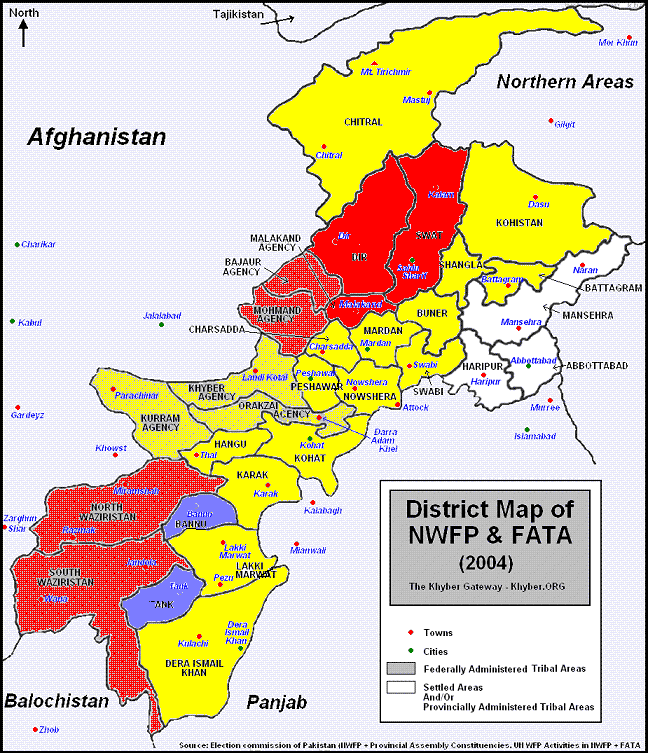
    Red agencies/ districts controlled by the Taliban; purple is de facto control; yellow is under threat

    Taliban commander Qari Hussain survived military operation in Waziristan
    By Bill Roggio
    May 25, 2008 10:18 PM

    A senior Taliban commander thought to have been killed in a Pakistani military operation in South Waziristan in January has turned up alive. Qari Hussain spoke to the media on May 23, just after Baitullah Mehsud said the Taliban would continue to attack NATO forces in Afghanistan.

    Hussain mocked the reports of his death at a press conference held at a government school building in South Waziristan. “I am alive, don’t you see me?” Hussain said.

    Qari Hussain is a senior lieutenant to Baitullah, the overall commander of the Pakistani Taliban. Hussain is a senior Taliban commander in the Mehsud tribe in South Waziristan. He runs suicide training camps that indoctrinate young boys between 9 and 12 years old. He is also described as a leading ideologue for the Taliban. "His extremist views are popular among Arabs, Uzbeks, and Afghan fighters," The Christian Science Monitor reported.

    Baitullah and Hussain had a falling out in June 2007 after Hussain launched a series of violent attacks on police in the tribal areas. Hussain's followers conducted beheadings and assassinations of tribal leaders in South Waziristan and the settled district of Tank. He was behind the attack on the home of the political agent of Khyber Agency, which resulted in the death of the agent's six family members and seven guests.

    The incident resulted in clashes between the two Taliban leaders as Hussain failed to obtain permission to conduct his campaign of terror. Baitullah retaliated by capturing 17 of Hussain's followers and threatened to kill them.

    While the incident prompted some Pakistani analysts to predict the fracturing and demise of the Taliban, the rift was smoothed over during the summer after the Taliban went on the offensive against the Pakistani military, government, and civilians. Hussain and Baitullah attended a jirga, or tribal council, that was formed to help free more than 300 Pakistani troops captured by the Taliban in South Waziristan.

    Hussain's home in Kotkai was destroyed by the Pakistani military in January. The Pakistani military launched an operation in South Waziristan on Jan. 24 after Taliban forces commanded by Baitullah overran two military outposts and conducted attacks against other forts and military convoys in the tribal agency. The military intercepted Taliban communications that indicated Hussain was killed in the assault.

    The Pakistani military reported Hussain may have been killed back in January, then reiterated that claim after taking reporters to one of Hussain's suicide camps in Spinkai in South Waziristan on May 18.

    "It was like a factory that had been recruiting nine to 12-year-old boys, and turning them into suicide bombers," said Major General Tariq Khan, the commander of Pakistan's 14 Division, which led the operation in South Waziristan.

    "The computers, other equipment and literature seized from the place ... give graphic details of the training process in this so-called ‘nursery,’" Dawn reported. "There are videos of young boys carrying out executions, a classroom where 10- to 12-year olds are sitting in formations, with white band of Quranic verses wrapped around their forehead, and there are training videos to show how improvised explosive devices are made and detonate

    SOURCE:

    XXXXXXXXXXXX

    Again the Taliban show they have no honor.

    suicide training camps that indoctrinate young boys between 9 and 12 years old, so-called 'nursery, as they can't get adults for suicide bombers.

    death of the agent's six family members and seven guests.

    Hussain failed to obtain permission to conduct his campaign of terror.

    Taliban have Suicide bombers dance the dance of death for a few media bytes.

    Taliban claims responsibility for mosque suicide bombing

    G

    Out Break of Taliban mental Illness.


    Labels: , , , , , , , ,